When shops invest in laser welding, the first safety conversation is usually about the beam. Enclosures, interlocks, and protective barriers get specified early, and for good reason. Laser radiation is a Class 4 hazard that requires engineered containment.
Laser welding also produces a second hazard: a plume of ultrafine metal particles released with every pass. Controlling that plume calls for its own engineering control, a welding fume extractor, and it belongs in the safety plan alongside the enclosure.
What's Actually in Laser Welding Fumes
Welding fumes form when metal is heated past its boiling point and the vapor condenses into solid particles. The result is a complex mixture of metal oxides, silicates, and fluorides, with most particles smaller than one micron. That's small enough to travel deep into the lungs.
The exact makeup depends on the material:
- Mild steel produces mostly iron oxide, with smaller amounts of manganese, chromium, and nickel.
- Stainless steel can generate hexavalent chromium, a confirmed human carcinogen, along with elevated nickel.
- Coated or galvanized metals add zinc, cadmium, and other compounds that cause metal fume fever and worse.
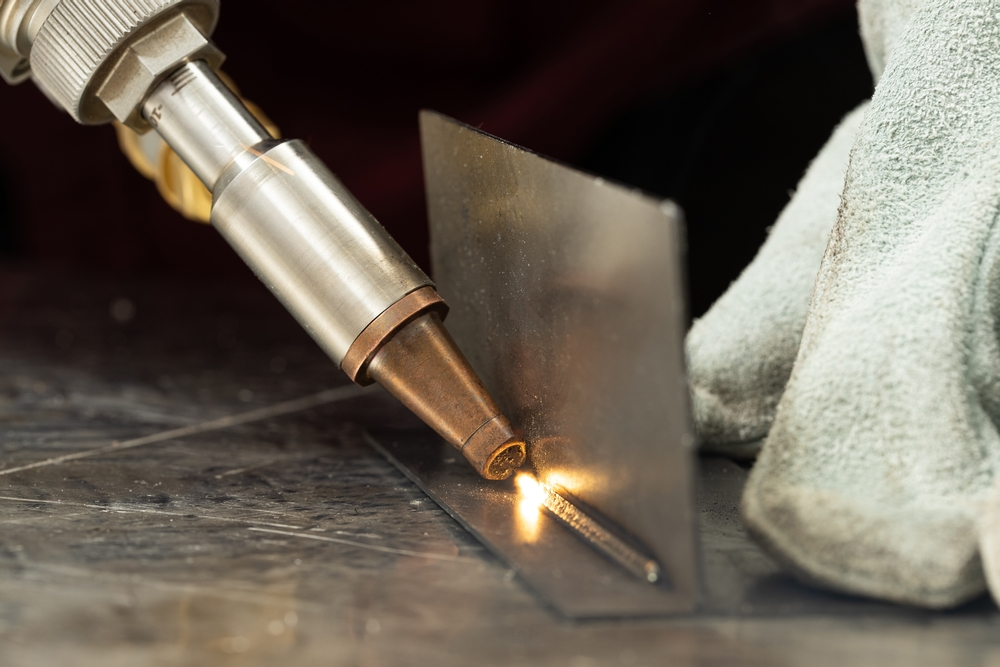
Laser welding adds two factors to this picture. The process runs at extremely high energy density, which produces a higher proportion of ultrafine particles than many traditional processes. And because handheld laser welding is fast and often done at close range, the operator's breathing zone can sit directly in the plume.
The Health and Regulatory Case Is Settled
Group 1 carcinogen. In 2017, the International Agency for Research on Cancer (IARC) reclassified welding fumes as carcinogenic to humans. The finding applied to mild steel welding, not just exotic alloys.
On the regulatory side, OSHA doesn't set one limit for welding fumes as a whole. It regulates the individual components, and some of those limits are strict. Hexavalent chromium, generated when welding stainless steel, carries a permissible exposure limit of just 5 micrograms per cubic meter as an 8-hour average under 29 CFR 1910.1026. Exposures above that level trigger regulated areas, medical surveillance, and other requirements most shops would rather avoid.
OSHA's guidance for meeting these limits follows the hierarchy of controls. Engineering controls come first, and the standard engineering control for welding fume is local exhaust ventilation: capturing the fume at the source before it reaches the welder. That is exactly what a welding fume extractor does.
Enclosures and Extractors Solve Different Problems
An enclosure and a fume extractor address separate hazards. An enclosure is designed to contain laser radiation and protect everyone outside the cell from stray beam exposure. It doesn't address airborne particulate, and without extraction, an enclosed cell can concentrate fume rather than control it.
Inside an enclosed welding cell with no extraction, several problems develop:
- Fume concentrates in the enclosed space instead of dispersing.
- Suspended particles can scatter or absorb the laser beam, degrading weld quality and consistency.
- Particulate settles on optics, fixtures, and finished parts.
- The moment the enclosure opens, accumulated fume vents into the shop.
The right approach treats the enclosure and the fume extractor as a matched pair. The enclosure contains the beam. The laser welding fume extractor captures the plume at the source, filters it, and returns clean air to the workspace. When you're defining the enclosure for a laser welding installation, fume extraction should be specified at the same time, not added later as a retrofit.
What to Look For in a Laser Welding Fume Extractor
The ultrafine particle load and the pace of laser welding place specific demands on extraction equipment, and not every welding fume extractor is designed for them. Four factors matter most when evaluating a unit.
1. HEPA filtration rated for ultrafine particles
Because laser welding fume skews so fine, the filter has to perform at the hardest particle size to capture. Look for a true HEPA filter rated 99.999% efficient at 0.3 microns. Particles both larger and smaller than 0.3 microns are captured even more effectively, so this rating covers the full range of laser welding fume.
2. A prefilter that protects the HEPA stage
A high-efficiency prefilter (F9 class or similar) removes the bulk of respirable dust before it reaches the HEPA filter. That extends HEPA life, keeps airflow strong, and lowers the cost of ownership. Rigid filter cartridges also matter, since sealed aluminum casings resist contamination bypass.
3. Airflow and capture velocity that hold up in practice
Fume capture only works if the air is moving fast enough at the source, and duct diameter has a significant effect on that. An 8-inch duct flows far more freely than a common 6-inch duct, which helps maintain OSHA-compliant capture velocity at a longer working range.
4. An arm that keeps up with the welder
Laser welding is faster than traditional processes, so the extraction arm gets repositioned constantly. A lightweight arm with freely articulating joints, and no internal structure obstructing the airstream, means the hood stays where the fume is without slowing the operator down.
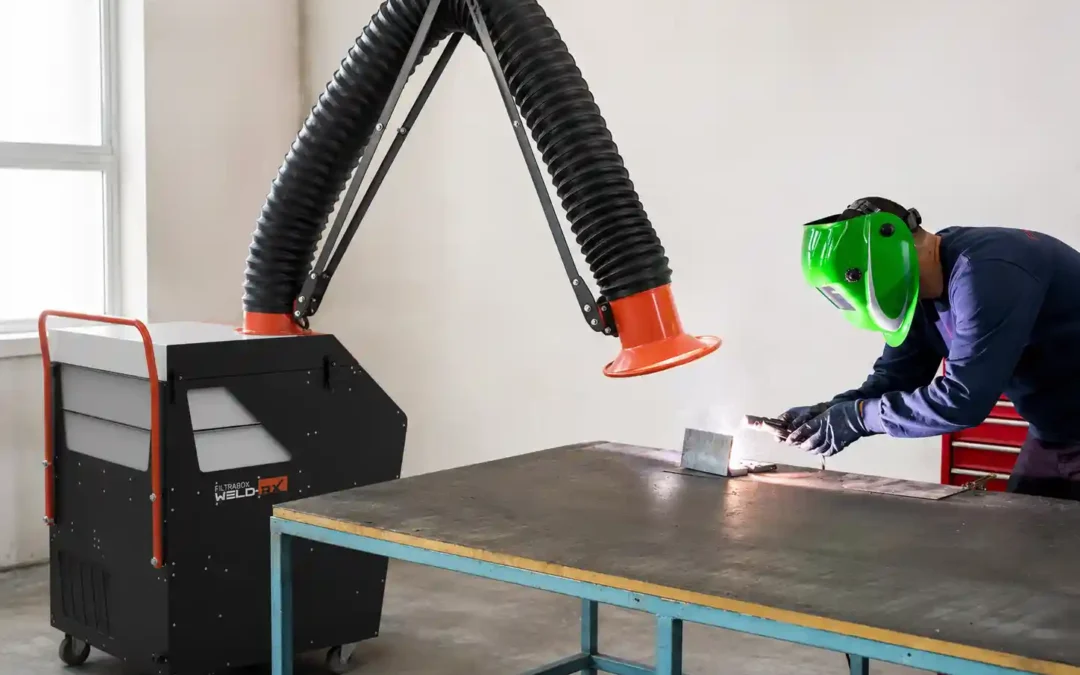
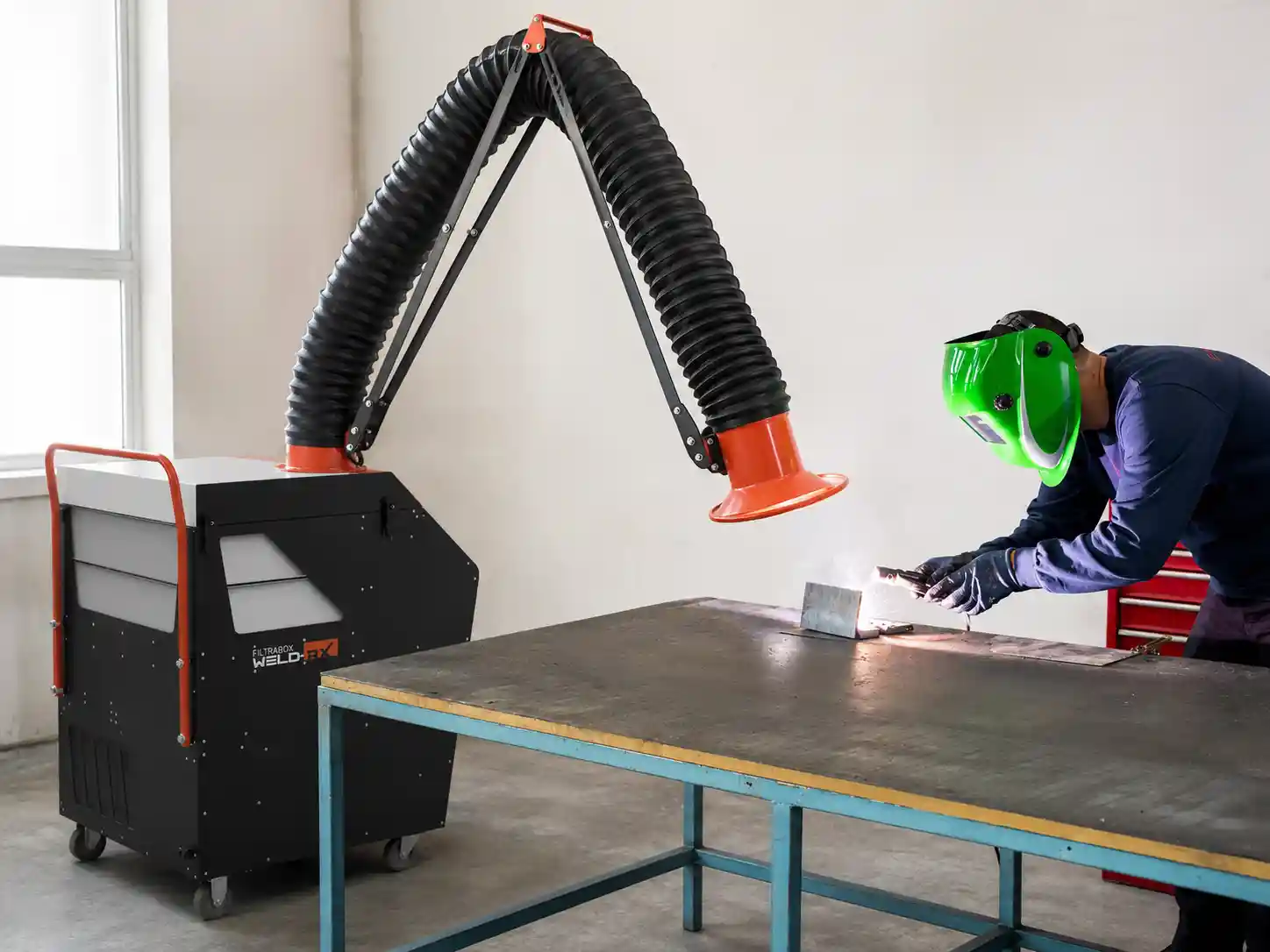
A purpose-built unit like the Filtrabox Weld-RX checks all four boxes: 99.999% HEPA filtration at 0.3 microns, an F9 prefilter, a 10-foot free-flow arm with an 8-inch duct, and plug-and-play operation on a standard 120V outlet.
The Bottom Line
Laser safety and air quality are two parts of the same decision. When specifying an enclosure for laser welding, specify source capture fume extraction with it. The health research supports it, OSHA's component limits require adequate controls, and local exhaust ventilation is the accepted engineering solution: capture the fume where it's generated, filter it to HEPA standards, and return clean air to the shop.
Sizing a fume extractor for your laser welding setup?
Our engineers can help you match extraction to your process, materials, and enclosure design.
Explore the Weld-RX